


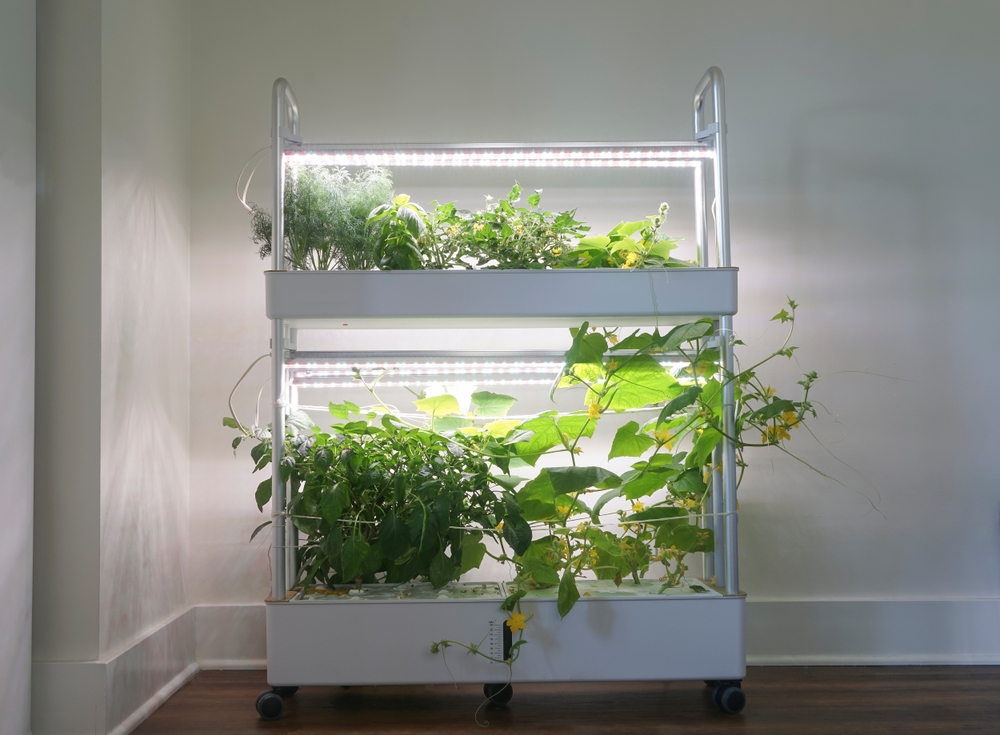
Walk into any grow shop or scroll through a product listing for LED grow lights, and you'll quickly run into a wall of acronyms. PPFD. PPF. DLI. PAR. Watts, lumens, efficacy. For someone just trying to figure out whether a light will actually grow their plants well, it can feel like you need a physics degree before you can make a buying decision. The truth is simpler than the marketing makes it look — but only once you understand what these numbers actually measure and why they matter. This guide breaks down LED grow lights, explains PPFD and PPF in plain language, and shows you how to translate those specs into real-world growing decisions.
Why Old Lighting Units Don't Tell the Whole Story
For decades, lighting was described in watts and lumens. Both units made sense for household bulbs — watts told you how much electricity the bulb used, and lumens told you how bright the light looked to human eyes. The problem is that plants don't see the world the way we do.
Human vision peaks in the green part of the spectrum, which is why lumens are weighted heavily toward green wavelengths. Plants, however, use mostly red and blue light for photosynthesis and largely ignore a big chunk of what we perceive as "bright." A light can look blinding to a person and still be mediocre for a canopy. It can also look dim and perform beautifully.
Watts, meanwhile, measure electrical consumption, not light output. A 300-watt LED fixture and a 300-watt HPS bulb draw similar power from the wall, but they don't deliver anywhere near the same usable light to the plant. Modern LEDs are significantly more efficient at converting electricity into photosynthetically useful photons. This is where the newer, plant-focused metrics come in.
PAR: The Light Plants Actually Use
Before we can talk about PPFD or PPF, we need to start with PAR. PAR stands for photosynthetically active radiation, and it describes the range of light wavelengths between roughly 400 and 700 nanometers — the part of the spectrum plants use for photosynthesis.
PAR isn't a unit of measurement. It's a category. Think of it as the "plant-relevant light" window. Everything below 400 nm (ultraviolet) and above 700 nm (far-red and infrared) falls outside the traditional PAR range, though modern research shows that wavelengths slightly outside this window — particularly far-red around 730 nm — still influence plant development.
When a manufacturer says their LED grow light "delivers PAR," they're simply saying it emits wavelengths plants can use. The real question is how much, and where. That's where PPF and PPFD enter the picture.
PPF: The Total Light a Fixture Produces
PPF stands for photosynthetic photon flux, and it measures the total number of photons in the PAR range that a light emits per second. The unit is micromoles per second, written as µmol/s.
In practice, PPF tells you the raw output of the fixture. It's a single number that describes the whole light, regardless of the space it's used in or the plants underneath it. A light with a PPF of 800 µmol/s produces twice as many usable photons per second as one rated at 400 µmol/s.
This is the first spec to check when comparing LED grow lights. It's also one of the few numbers that's relatively hard to fudge, because it's measured in a controlled environment called an integrating sphere. A reputable manufacturer will publish this figure clearly, often alongside a third-party test report.
However, PPF by itself doesn't tell you whether a particular light is right for your tent or bench. A fixture with a huge PPF could still underperform if the light is spread too thinly across a large area — or oversaturate a small space and damage plants. That's why PPFD matters just as much.
PPFD: The Light That Actually Reaches the Canopy
PPFD stands for photosynthetic photon flux density, and it measures the number of PAR photons landing on a specific area per second. The unit is micromoles per square meter per second, or µmol/m²/s.
This is the number that directly reflects what your plants experience. Two fixtures with identical PPF numbers can deliver very different PPFD depending on the height they're hung at, the footprint they cover, and the optics or reflectors used. In practice, PPFD is the metric you use to dial in your grow.
Different plants prefer different PPFD ranges, and even the same plant prefers different ranges at different life stages. Seedlings and young clones thrive at around 100–300 µmol/m²/s. Vegetative growth ramps up into the 400–600 range. Flowering stages for light-hungry crops push into 700–1000+ µmol/m²/s, and with supplemental CO2, some plants can make use of even higher values without stress.
Go above those ranges without proper environment and you start bleaching leaves, stressing plants, and wasting electricity. Stay below them, and you get slow, leggy growth with disappointing yields. PPFD is the sweet-spot dial.
PPFD Maps: Why Averages Can Be Misleading
Here's where things get tricky. Manufacturers often quote a single PPFD number, sometimes labeled "average" or "center." That number can be dramatically different from what the corners of your canopy actually receive.
Most quality LED grow lights now come with PPFD maps — grids showing the photon flux density at multiple points across the footprint, usually at a specific hanging height. A good map shows consistent values from edge to edge, with perhaps a 20–30% difference between center and corners. A poor map shows a hot spot directly under the light and sharp drop-offs at the edges.
In real growing, uniformity matters as much as intensity. A plant sitting in a corner with 300 µmol/m²/s will underperform its neighbor sitting under 700, even in the same tent. Uneven light means uneven growth, uneven ripening, and uneven final results. When comparing LED grow lights, always check for a proper PPFD map rather than a single quoted value.
Efficacy: Getting the Most Out of Every Watt
There's one more number worth understanding, because it ties the others together: efficacy, measured in micromoles per joule (µmol/J). Efficacy tells you how efficiently a fixture converts electricity into PAR photons. Divide the PPF by the wattage, and you get efficacy.
Modern quality LEDs sit between 2.5 and 3.0 µmol/J, with premium fixtures pushing beyond 3.0. Older LEDs and cheaper builds often fall below 2.0, which means they produce less usable light for the same electrical cost. Over a full grow cycle — several hundred hours of operation — that efficiency difference adds up to real money on your bill.
Warto pamiętać — a cheap light with low efficacy isn't actually cheap. It costs more to run, produces less output, and often has poor thermal management that shortens its lifespan. Spending more upfront on a higher-efficacy fixture usually pays back within one or two grow cycles.
DLI: The Daily Light Integral
Once you understand PPFD, it's worth adding one more concept: DLI, or daily light integral. DLI measures the total amount of PAR light a plant receives over a full day, combining intensity and duration. The unit is moles per square meter per day (mol/m²/day).
The math is simple: multiply PPFD by the number of seconds the light is on, then divide by a million to convert micromoles to moles. A plant receiving 600 µmol/m²/s for 18 hours gets a DLI of about 38.9 mol/m²/day.
Different plants have different DLI targets. Leafy greens and herbs do fine with 12–20 mol/m²/day. Fruiting and flowering crops often want 25–40. Some high-light species thrive with 40+ when environmental conditions support it. Thinking in DLI terms is useful because it forces you to consider intensity and photoperiod together, rather than treating them as separate decisions.
Matching LED Grow Lights to Tent Size
Theory is nice, but the real question most growers have is simple: which light fits my space? The answer comes from matching your tent footprint to the light's PPFD map at a reasonable hanging height.
A 60×60 cm tent typically needs a fixture with 100–150 watts of quality LED output, producing around 250–400 µmol/s of PPF. For 80×80 cm tents, target 200–250 watts and 500–650 µmol/s. A 100×100 cm tent pairs well with 300–400 watts and 750–1000 µmol/s of PPF. For 120×120 cm setups, look at 600+ watts and 1500+ µmol/s.
These are rough guides. What actually matters is whether the PPFD map shows your target intensity across the entire footprint at your planned hanging height. Some premium 240-watt lights outperform cheaper 400-watt units because of better LED chips, better drivers, and better optical distribution.
In practice, it looks like this: two lights with identical wattage can deliver very different canopy experiences. The one with better diodes, a better driver, and a properly designed board always wins — even if it costs more per watt.
Spectrum: What About White, Red, and Blue?
Beyond raw numbers, LED grow lights also differ in spectrum. Early generations used purple "blurple" lights — heavy on red and blue diodes because those are the wavelengths with the highest photosynthetic response per photon. They looked strange and made plant inspection difficult, but they worked.
Modern quality fixtures use full-spectrum white LEDs, often supplemented with additional red (around 660 nm) and sometimes far-red (730 nm) or UV diodes. Full-spectrum white light provides the broad, balanced wavelength profile plants evolved under, including useful amounts of green light that actually penetrates deeper into the canopy than older assumptions suggested.
For most growers, a high-quality full-spectrum LED with a CRI of 80 or higher is the right choice. It works well across all growth stages, makes plant inspection and diagnostics easier, and doesn't require complicated switching between veg and flower modes. Specialized spectra have their place in research and commercial operations, but for a home grow tent, full-spectrum is both simpler and generally just as productive.
How to Read a Spec Sheet Without Getting Fooled
Marketing for LED grow lights can be aggressive, and a few tricks show up repeatedly. Knowing what to look for saves money and disappointment.
First, watch for "equivalent wattage" claims. A light advertised as "1000W equivalent" that actually draws 150W from the wall is using a marketing number, not a real one. The only wattage that matters is actual electrical draw, sometimes labeled "true watts" or "power consumption."
Second, be skeptical of lumen-based specs. Lumens tell you almost nothing about plant growth. If a grow light's main spec is lumens, the manufacturer is either targeting uninformed buyers or hiding weaker PPF numbers.
Third, check whether PPFD values are quoted at a realistic hanging height and whether a map is provided. A PPFD of 1200 µmol/m²/s at 15 cm from the light is a very different claim from 1200 µmol/m²/s at 40 cm across a 100×100 footprint.
Fourth, look for third-party testing. Reputable brands publish independent lab reports — sometimes called an LM-79 or an IES file. If no test data exists and all the numbers come from the manufacturer's own marketing, treat every spec with skepticism.
Finally, consider the driver and the warranty. A cheap LED board paired with a cheap driver will fail early, often within a year. Quality drivers from established manufacturers carry multi-year warranties. The driver is the most failure-prone component in any LED grow light, so it's worth knowing what's inside the fixture you're buying.
Practical Tips for Using LED Grow Lights Well
Even the best light is only as good as the setup around it. A few habits make a measurable difference.
Start plants at lower intensities and work up. Dropping a seedling under 800 µmol/m²/s is a fast way to stress it. Raise the light higher in early stages, then lower it as plants mature and demand more energy. Most LED fixtures now include dimmers — use them.
Measure, don't guess. A quality PAR meter or a good smartphone PAR app gives you real numbers at canopy height. Knowing that you're actually delivering 650 µmol/m²/s rather than hoping you are changes how confidently you grow. Entry-level PAR meters have gotten affordable enough that they belong in any serious toolkit.
Keep an eye on distance. LED grow lights don't lose intensity linearly with distance — they drop off following an inverse-square relationship, meaning doubling the distance cuts intensity to a quarter. Small adjustments in hanging height make surprisingly large differences in canopy PPFD.
Don't ignore heat, even with LEDs. While LEDs run cooler than HPS, they still produce heat, and stagnant warm air sitting just above the canopy will stress plants even when the light intensity is perfect. Pair your lighting with proper extraction and air circulation.
Match your environment to your intensity. High PPFD demands more CO2, more water, more nutrients, and better temperature control. Pushing light intensity without also pushing the supporting environment leads to worse results than simply running at a moderate PPFD with everything else dialed in.
When More Light Isn't More Yield
A common misconception with LED grow lights is that higher PPFD always means more growth. Up to a point, it does — but plants have a saturation threshold, beyond which adding more light produces diminishing returns and eventually damage. That threshold depends on the species, the CO2 concentration, the temperature, and nutrient availability.
For most common crops in a home grow, PPFD above 1000 µmol/m²/s without CO2 enrichment starts hitting the law of diminishing returns. The plant simply can't use photons faster than its biochemistry allows. Adding more light past that point just wastes electricity — and if pushed further, it actively harms the plant through photooxidative stress, leaf bleaching, and reduced secondary metabolite production.
Growers who invest in supplemental CO2 can push into higher PPFD ranges productively, because CO2 is usually the limiting factor at high light intensities. Without that environmental upgrade, chasing ever-higher PPFD numbers on your spec sheet doesn't translate into proportionally better plants.
Summary: Making Sense of LED Grow Lights
Understanding LED grow lights doesn't require memorizing every acronym — it requires knowing which numbers matter and why. PAR describes the range of light plants use. PPF measures the total photons a fixture emits per second. PPFD measures what actually arrives at the canopy. Efficacy tells you how efficiently electricity becomes usable light, and DLI captures the total daily light a plant receives.
When comparing lights, prioritize true wattage, published PPF, a proper PPFD map at a realistic hanging height, and an efficacy of at least 2.5 µmol/J. Ignore lumens and equivalent wattage claims. Match the light's footprint to your tent, start intensity lower for young plants, and push the environment to match the intensity rather than the other way around.
The most important thing to remember is that LED grow lights are tools, not magic. A well-chosen light paired with solid ventilation, steady climate control, and a grower who pays attention will outperform a more expensive fixture used carelessly every time. Learn the numbers, trust your measurements, and let the plants themselves tell you whether the setup is working. Over one or two grow cycles, the acronyms stop feeling like jargon and start feeling like the everyday language of getting better yields from less electricity — which is, in the end, exactly what modern LED grow lights were built to do.


 Zaloguj przez Facebooka
 Zaloguj przez Google